


Scarf 56 | Pure Alpaca · vlad.œuvre
Scarf 56 | Pure Alpaca · vlad.œuvre

Couldn't load pickup availability
The From The Andes Priority Promise.
Select USPS Ground Advantage and eligible U.S. orders are automatically upgraded to USPS Priority Mail at no additional cost.
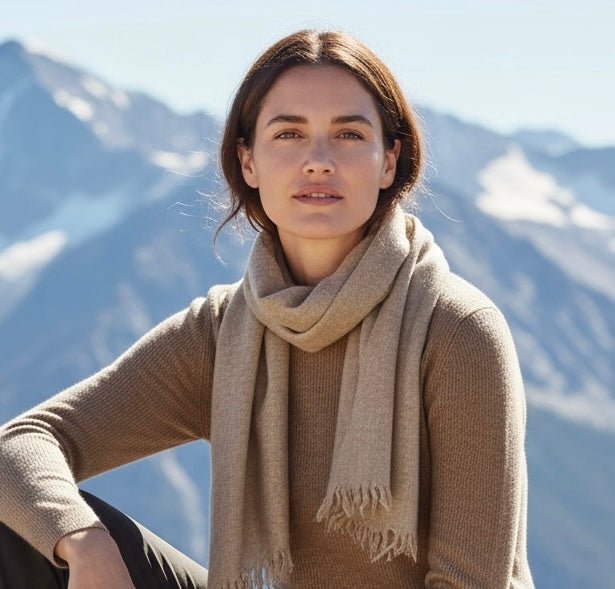
Scarf 56 is hand-loomed in Bolivia from 100% undyed alpaca, using the natural color of the fiber rather than added dye. The approximately 56-inch length and 8.75-inch width make it compact enough to tuck into a coat while still giving enough fabric for a simple wrap or knot.
The loom-woven construction gives the scarf a clean, structured drape without unnecessary bulk. Natural color variation is part of the material and will differ slightly from piece to piece.
Details
- Origin: Bolivia
- Material: 100% alpaca
- Color: Undyed natural fiber tones
- Construction: Hand-loomed
- Length: Approximately 56 in
- Width: Approximately 8.75 in
- Variation: Natural fiber color and hand-loomed finish may vary slightly
Care: Spot clean when possible. For a full cleaning, hand wash cold with a wool-safe cleanser and lay flat to dry, or professionally dry clean. Store folded.


Top FAQs Answered 🌟 frequently asked questions
Will I receive the exact item shown?
If a product is listed as one-of-one, vintage, a unique specimen, or the exact piece photographed, that is the piece you will receive. Repeatable apparel and multi-unit products may use representative photography and will match the purchased style, size, color, and listed specifications.
Are all your items handmade?
No. Many pieces are handmade, hand-knit, handwoven, carved, assembled, or produced in small quantities. Others are commercially produced. We state the material, construction, maker, origin, and technique on the individual product page when those facts are known.
Do you restock sold-out items?
Sometimes. Core apparel and repeatable merchandise may return when available. One-of-one, vintage, limited, and unusually sourced pieces often do not. If inventory says one, there may really be only one.
What determines the price of a piece?
We consider material, fiber content where applicable, construction, finishing, origin, workmanship, production quantity, condition, and the finished piece itself. Price makes sense only after you know what you are comparing.
What is your return policy?
All products may be returned within 30 calendar days after delivery. Merchandise must be unused, unworn, and in original condition. Contact info@shopfromtheandes.com to request a return. Approved U.S. returns include a prepaid return label paid by From The Andes. Eligible returns may receive a refund of the merchandise price, an exchange, or store credit, with no restocking fee. Approved refunds are initiated within 3 business days after inspection, and From The Andes pays outbound shipping on approved exchanges.
Returns require prior authorization and must meet the condition requirements in our Refund Policy.
Where does my order ship from, and how quickly?
Orders ship from Ranchos de Taos, New Mexico, and typically leave within 1 business day. Orders placed after 12:00 p.m. Mountain Time typically ship the following business day. Orders placed on weekends or recognized holidays typically ship the next business day. Handling time is separate from carrier transit time. We use USPS or UPS and provide tracking. USPS currently publishes a 2–3 business day service objective for Priority Mail after USPS accepts the shipment; Priority Mail delivery is not guaranteed.
Where do you ship?
We ship to eligible addresses within the United States and supported U.S. territories, including Alaska, Hawaii, Puerto Rico, supported U.S. territories and possessions, and eligible APO, FPO, and DPO addresses. Orders of $75 or more receive complimentary shipping. When an eligible order is placed with a Ground shipping service, From The Andes upgrades it at no additional charge to USPS Priority Mail or an available carrier service that provides an equal or faster service level.
Alpaca benefits
What makes alpaca fiber distinctive comes down to the fiber itself and how the garment is made.
Finer alpaca fibers generally feel more comfortable against the skin. Fiber diameter and medullation both influence softness and prickling, so the feel of alpaca can vary from garment to garment.
Alpaca fiber is valued for thermal insulation, and medullation within the fiber can contribute to that performance. We do not use fixed claims such as “three times warmer than wool” because warmth depends on the finished yarn, knit, weight, and garment construction.
Alpaca is a natural protein fiber. We avoid blanket claims such as “hypoallergenic,” “antimicrobial,” or “allergy-free” because individual sensitivities vary and those terms can overstate what the fiber itself guarantees.
Like other fine animal-fiber knitwear, alpaca can pill or show surface wear where friction occurs. Fiber selection, yarn structure, garment construction, use, and care all affect durability. Gentle cleaning and proper storage help preserve the piece.
Alpacas have been raised for fiber in the Andes for centuries. Modern garment quality still depends on the specific fleece, fiber preparation, spinning, knitting, finishing, and care behind each piece.